Clay Testing Pt. 5 (More issues)
Welp Here we are again. After the previous testing round had finished I felt confident enough to start using the successful recipe in real work. I began making assortments of mugs, bowls, vases, etc with success! I felt I had moved from the testing stage into a honing stage. I could begin figuring out glazes, slips, and decorations that would fit an aesthetic that all somewhat centered around the clay color.
Fast forward to Sunday the 26th of February. I unloaded our gas kiln with a large batch of new work. Even with this confidence in my clay I still like to quality test my pieces to make sure they can handle thermal shock. I picked a handful of pots and poured boiling water inside and of course they were almost all met with a loud dunting noise. Very few made it through and now I am gathering the mental energy to kick off a new round of testing.
I have been reading up much more about causes of dunting and have found quite a lot of valuable information. On page 89 of “Pioneer Pottery” by Michael Cardew, he talks about clay bodies he had formulated and the limits he used to go forward with creating a stoneware clay bodies. It was surprising to see that he would expect around 18 to 20 percent of feldspar for a clay body. My recipe has a measly 5 percent in comparison. Even though he is using this reference to a stoneware body fired to cone 8 or 9, it still shows I should be increasing the amount of feldspar in my clay. That will be my first starting point in my next batch of tests
To start the next round I will be increasing the amount of feldspar in my clay in increments of 2%. I will start at 8 and go up to maybe 14 or 16 depending on how I feel. The earlier tests were sitting at 10 percent and that was enough to cause bloating. My hope is this increase won’t bring that issue back. The recipes for those tests will be listed as follows:
Newmans Red Fireclay 44%, C & C Ball Clay 22%, Unami Creek Clay 17%, Grolleg Kaolin 9%, G200 Feldspar 8%
Newmans Red Fireclay 43%, C & C Ball Clay 22%, Unami Creek Clay 16%, Grolleg Kaolin 9%, G200 Feldspar 10%
Newmans Red Fireclay 42%, C & C Ball Clay 21%, Unami Creek Clay 16%, Grolleg Kaolin 9%, G200 Feldspar 12%
Newmans Red Fireclay 42%, C & C Ball Clay 21%, Unami Creek Clay 15%, Grolleg Kaolin 8%, G200 Feldspar 14%
Newmans Red Fireclay 42%, C & C Ball Clay 21%, Unami Creek Clay 13%, Grolleg Kaolin 8%, G200 Feldspar 16%
Another avenue to consider is to change what feldspar I am using. I use the website Digitalfire as it has been a tremendous tool to get a mass of info on a variety of materials. While researching different feldspars, I found that Custer feldspar seems to have a slightly higher melting point than G200. There was a photo of a melt test comparing several materials and Custer seemed to have one of the lowest melts. Don’t get me wrong this is still just an estimated guess. I have no idea if this will work but its worth a try. If it does work I could theoretically increase the feldspar content in the clay without fluxing the body too much.
One reason I feel my theory is supported is when I use the recipe calculator on Glazy.org (another fantastic tool for recipes and materials) the Custer substitute shows to be slightly more refractory. Ive taken a screenshot and you’ll see two dots on the graph. The top right one is the target calculation of the Custer recipe and the bottom left is the G200.
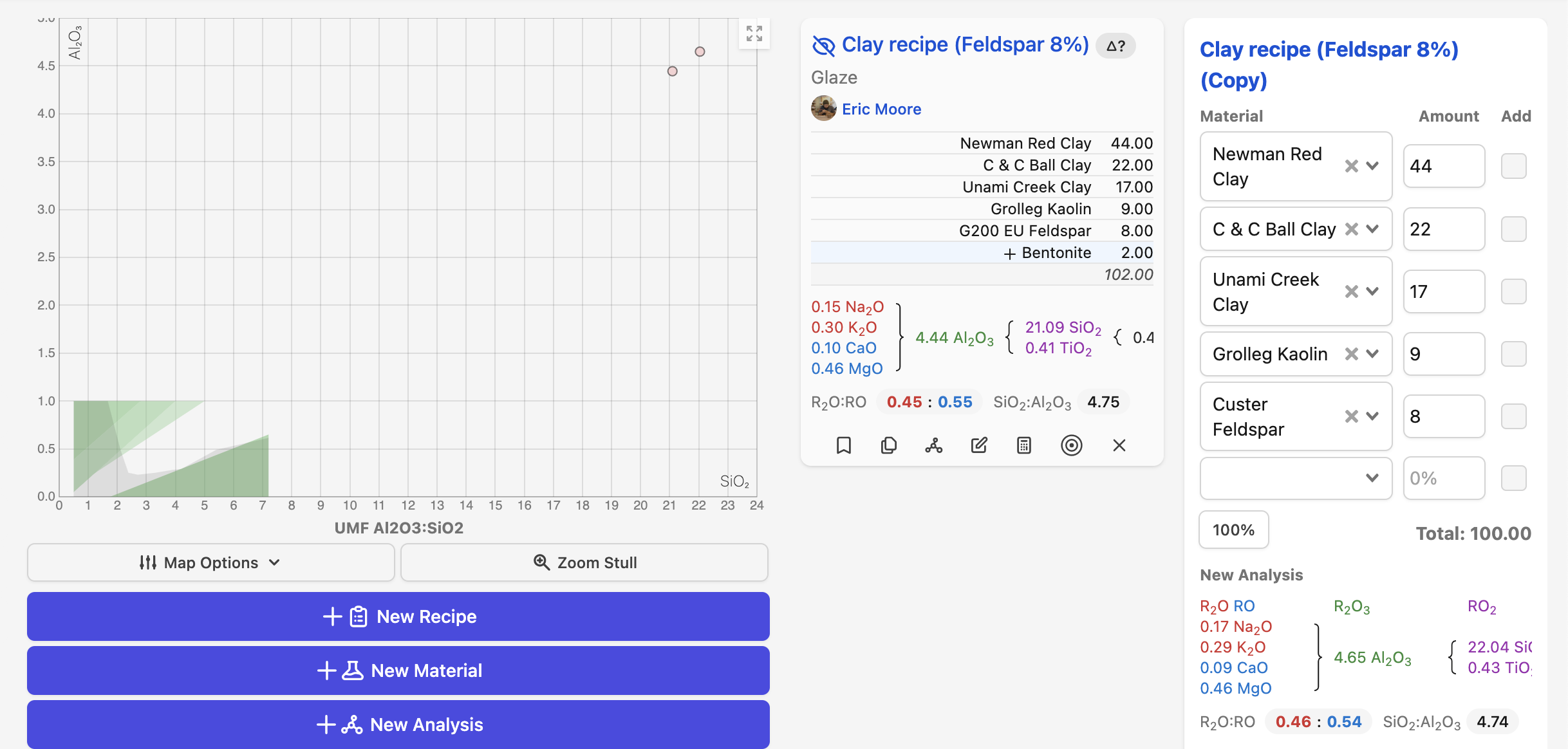
The recipe I’ll use for that test is shown below:
Newmans Red Fireclay 44%, C & C Ball Clay 22%, Unami Creek Clay 17%, Grolleg Kaolin 9%, Custer Feldspar 8%
Newmans Red Fireclay 43%, C & C Ball Clay 22%, Unami Creek Clay 16%, Grolleg Kaolin 9%, Custer Feldspar 10%
Newmans Red Fireclay 42%, C & C Ball Clay 21%, Unami Creek Clay 16%, Grolleg Kaolin 9%, Custer Feldspar 12%
The next direction I have been thinking of is adding Kyanite to the recipe. Taken from the digitalfire material page for kyanite, it is “a super-duty refractory material, with low thermal expansion so their presence in a material imparts resistance to thermal shock.” It’s also stated that you could add up to 15 percent to help with throwing properties in addition to helping with thermal shock. So for those tests the mixes will be as follows:
Newmans Red Fireclay 39%, C & C Ball Clay 20%, Unami Creek Clay 13%, Grolleg Kaolin 8%, Custer Feldspar 10%, Kyanite Clay 10%.
Newmans Red Fireclay 39%, C & C Ball Clay 20%, Unami Creek Clay 11%, Grolleg Kaolin 8%, Custer Feldspar 10%, Kyanite Clay 12%.
Newmans Red Fireclay 39%, C & C Ball Clay 20%, Unami Creek Clay 9%, Grolleg Kaolin 8%, Custer Feldspar 10%, Kyanite Clay 14%.
We shall see how these all work out. I have a few more ideas up my sleeve but I want to get all of these made first and get some throwing results as well. Despite wanting to increase the refractory nature of the clay, I still want the clay to be plastic to throw with. The battle really comes down to changing all of the minutia without giving up any positive characteristics. The boiled down goal is to have a nice dark clay body that has good working properties, can withstand up to cone 11R (mainly to be safe), and is resistant to bloating and dunting.